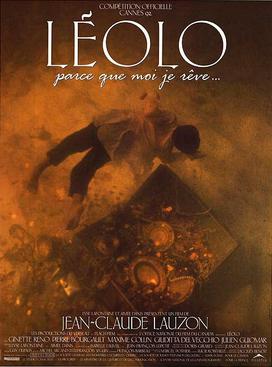
 Watching the start of Jean-Claude Lauzon’s 1992 Québécois film, Léolo, it doesn’t feel like a normal movie. It feels like prying into an adult’s most intimate, unfiltered memories of his youth. Between the haunting chanting on the soundtrack and the grainy footage, there is a heavy, uncomfortable vibe right from the opening.
As the adult narrator talks about his childhood, the screen keeps fading to black. It feels almost like he’s blinking away memories that are too hard to look at for very long.
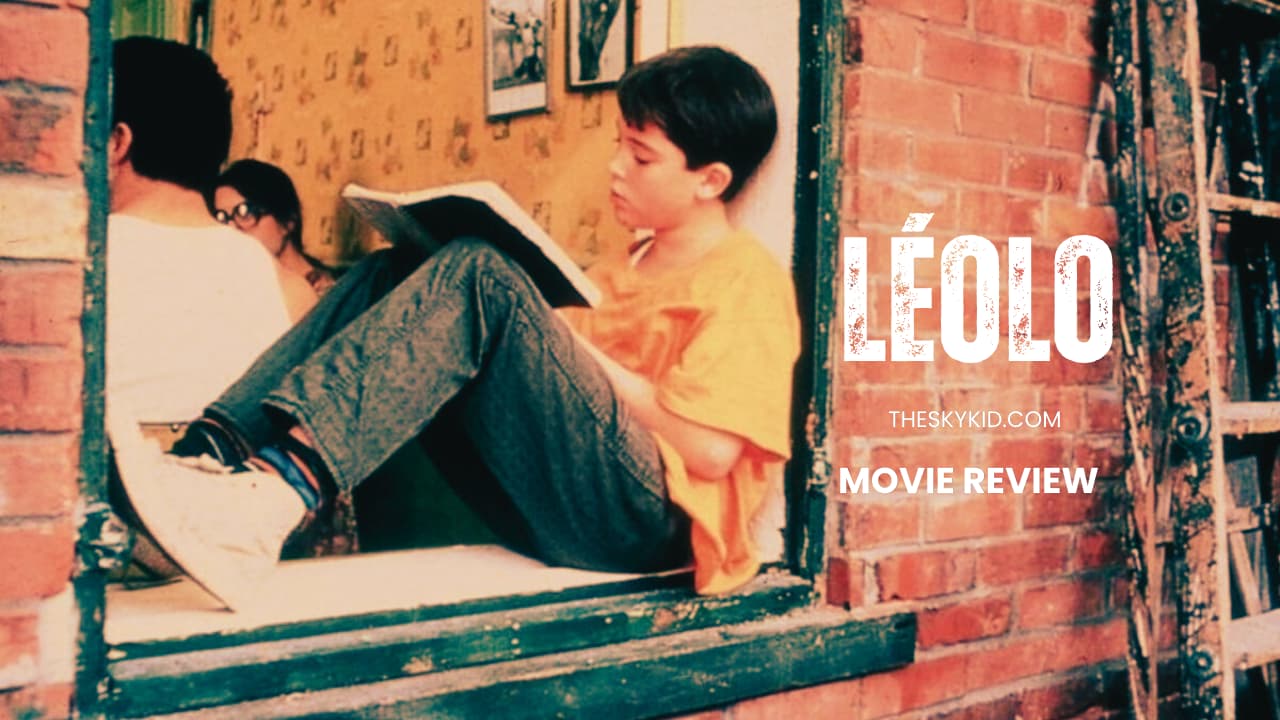
The atmosphere in the house is punctuated by bizarre, awkward family rituals. But then the film gives us a simple scene of Léolo reading on his balcony, silently watching the neighbor girl he is deeply in love with. This isn’t your typical childhood crush; it’s an obsession that reshapes his entire identity. He watches her change clothes or perform “favors” for his grandfather, and instead of turning away, he uses her as the blueprint for his escape.
The movie focuses on everyday sounds like laundry flapping in the wind, finding pure poetry right in the middle of poverty. He escapes into those daydreams because he has to.
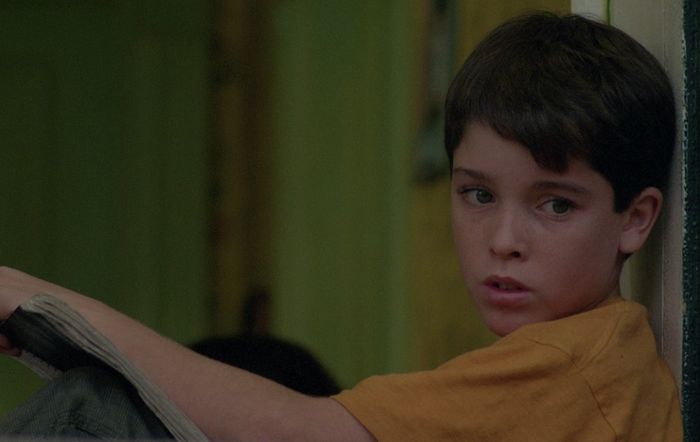
None of this voyeurism would work without Maxime Collin, who plays the young Léolo. He is extremely sympathetic and delivers a remarkably strong, convincing performance. There is a raw authenticity to him that makes the film feel almost documentary-like, as if the director is simply saying, “Here is the boy I was.” The film doesn’t necessarily force you to fully identify with the protagonist, but Collin’s presence easily involves you in the story.
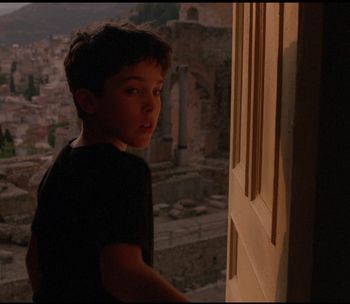 His performance is quiet and observational, which seamlessly matches the film’s voyeuristic tone. He has these incredibly expressive, soulful eyes that convey an entire inner world: watchful, melancholic, and prematurely wise. The adult voice-over works beautifully precisely because Collin’s on-screen presence grounds every poetic line in lived truth. Without his subtle, grounded performance, the film’s delicate blend of poetry, horror, and dark humor would completely collapse.
The moment that truly hooked me was how the movie shows his birth. We see a surreal fantasy where a market truck spills its load, and his mother tumbles into a massive mountain of red tomatoes. Instantly, the film cuts straight to him being born in a hospital. It took me a second to realize what was happening: Léolo is using his imagination to completely reject his own family. He decides those red tomatoes made him Italian. He isn’t Leo, he is Léolo. It’s a brilliant, sad way to show how a kid uses daydreams as a shield to survive his own life.
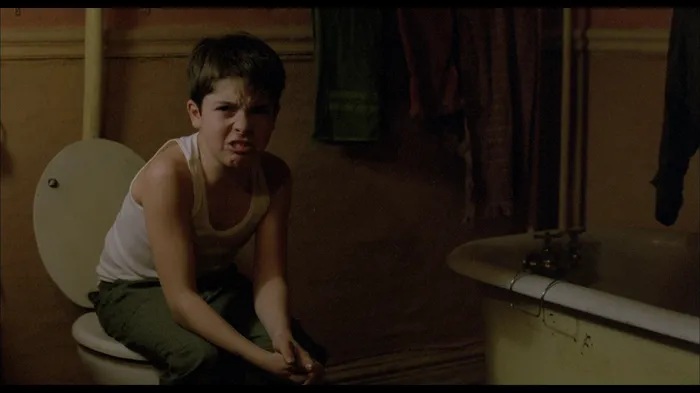
As the film goes on, the voyeurism shifts, becoming incredibly intimate and surprisingly exciting. There are these scenes where Léolo starts discovering his own body—or, as he calls it, the “tail between his legs.”
We watch him from above, locked in the bathroom with a hidden magazine, exploring with pure curiosity. He even does some wild, messy experiments with a piece of a pig’s liver. The most honest part of it is that he figures out he likes it, so he keeps doing it over and over.
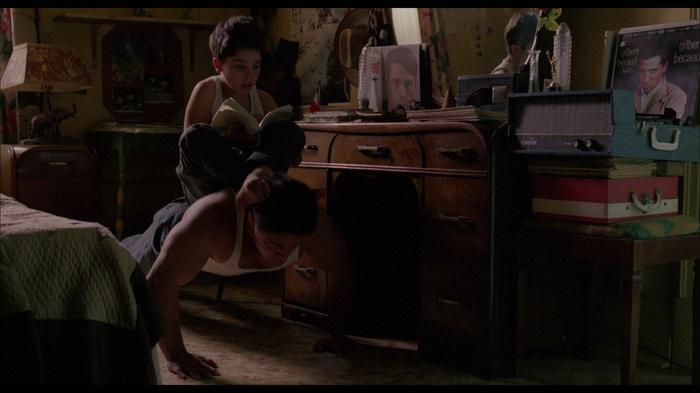 Sitting there watching his new obsession, I was intrigued and honestly found it kind of cute. It instantly brought back the awe and sheer awkwardness of my own preteen experimentations. The movie acts as a profound mirror, and I think it is absolutely inevitable that anyone who watches this film will find their own clumsy, secret memories flashing right over Léolo’s.
As the film moves into its second half, the pacing opens up, throwing a wider variety of wild experiences at us and weaving in this brilliant, biting dark humor. But underneath the laughs, the film’s terrifying reality comes into full focus: Léolo’s family is genuinely, clinically ill.
Through all this bleakness, that calm, poetic voice-over acts as a life raft. It constantly tricks us into believing these are nostalgic memories and that everything will eventually be okay, keeping us floating above the crushing tragedy of his reality.
As a whole, Léolo is an exemplary Coming-of-Age film, but it requires a specific interest in the genre to fully appreciate it. Because it is a Québécois production, it has a distinctly raw aesthetic that puts it on par with Scandinavian cinema, rather than your typical Hollywood movie.
A general audience might find the first half a bit too slow or philosophical and be tempted to give up. Don’t. If you accept the role of the voyeur and give it a chance, the second half pays off in ways that are deeply intriguing and completely unforgettable. If you want a movie that doesn’t gloss over youth, but actually makes you feel the messy, tragic, and beautiful reality of it, Léolo is an absolute must-watch.