There is no television show behind Francisco Maya. No label launch, no talent-show edit, no backstory package.
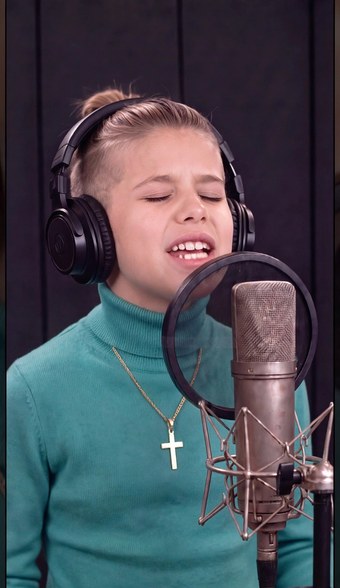
There is a boy in a dark studio, headphones too big for him, a gold cross at his throat, singing into a condenser microphone — and, as of this writing, some 76,000 people on TikTok who found him there and stayed.

Francisco Maya is a young Spanish singer, a child still, working in flamenco. That last word matters, because flamenco never learned to shrink its songs for children. The repertoire is the repertoire: love, loss, loyalty, death. He sings all of it.
Sung without a blink
This is the thing about him, and it is the best thing. One song is Tu Piel De Canela — your cinnamon skin, your black hair, they steal my calm and give me heaven — a grown man’s desire, sung without a blink.
Another is Me La Voy a Llevar, the old flamenco threat-promise to carry the beloved off and let the world fall where it likes. He delivers both the way he delivers everything: eyes closed, completely inside the feeling, as if it were already his own life.
Then, in the next breath, he sings Me Gustas de Verdad — and the scale changes completely. I blush when her hand brushes mine as she passes. Her name is drawn at the back of my notebook. A schoolboy’s crush, at exactly a schoolboy’s size, and just as true.
The adult songs are not a costume and the child’s song is not a retreat. He means all of it, at full strength, and the listener holds the two together: the innocence, and the borrowed longing far beyond his years. That tension is the performance. It cannot be taught, and it cannot survive growing up — which is precisely why it deserves to be witnessed now.
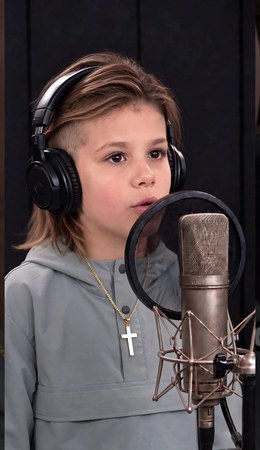
His own world
His own world is in the songs too. His signature piece, Qué Bonito es el Compás, is a gratitude list set to rhythm: waking with the sun, his mother singing in the corner, his grandfather’s hug, playing in the plaza until nightfall. No hace falta mucho para ser feliz — you don’t need much to be happy.
And Mi Estrella en el Cielo turns to the one who is no longer there: a star in the sky who still guides him, protects him, heals his soul from above. Between the love songs and these, you get the whole map of a boy’s heart — family behind him, faith around him, and a grown man’s repertoire waiting in his mouth.
The voice before the machinery
The operation is small and serious. The songs are written for him — songwriter Jorge Márquez Martínez is credited across the releases — recorded in that same dark studio, and published under the boy’s own name.
An EP, Raíz De Niño (“Child’s Root”), arrived in September; since then the singles have come almost weekly: Anhelo de Libertad, Mi Estrella en el Cielo, Qué Bonito es el Compás. His Spotify audience — some 12,700 monthly listeners, concentrated in Madrid, Barcelona, Seville, Málaga and Valencia — is entirely Spanish and entirely earned the slow way, clip by clip, share by share. There is no press. There is barely a biography. Nobody can even tell you how old he is.

theskykid.com has spent twenty years looking for exactly this: the voice before the machinery arrives. This one, I should say, is not my find — my father heard him first and passed him to me, which feels right for a singer whose songs are all about what a family hands down.
Flamenco crossed this site’s path early. In 2009 we covered Ricky Rodríguez, a young flamenco dancer set to star in a film called Muchacho Del Flamenco — a project I believed in and did what I could to promote. The film was never made. It remains one of this archive’s quiet regrets: a talent announced, covered, believed in — and then the project vanished, and with it almost every record of what he could do.
That same year we interviewed Antonio José, long before La Voz and everything that followed. He got his season. Ricky didn’t. The pattern underneath both is the same — first there is a child and a gift, and the feeling is real, and everything else is built afterwards on top of it.
Francisco Maya‘s voice will change. Every boy singer this site has championed carries that clock inside the gift; it is what makes the recordings documents rather than just performances. What exists right now — a child standing in the dark, singing the whole flamenco book like he has already lived it — is a brief season, and it is open.
Listen while it’s his.
— Francisco Maya on TikTok: @francisco.maya522 · Instagram: @_maya.francisco · Spotify: Francisco Maya