Shadow Of A Midsummer Night ( Midsommernattens Skygge) is a short Coming-of-Age film from Norway about a nine-year-old boy who loses his friend in an accident.
The movie focuses on friendship, grief, support and overcoming sorrow. Beautiful cinematography (courtesy of Kai Miedendorp) relying on lens flare, and bright, warm colors evoke an almost fairy-tale sense of the picture.
Today I will review a book that was considered controversial when it was first released (back in 1969). It is a book written by John Donovan and has a rather intriguing title: I’ll Get There. It Better Be Worth The Trip. The protagonist of the book is a 13-year-old boy named Davy who has to move from a small town in Massachusetts to New York to live with his mother, after the death of his beloved grandmother who took care of him ever since his parents divorced more than five years before. The boy describes the horrid experiences of losing someone you love and having to adjust to a completely new environment:
“There aren’t many adults I have anything to say to, and now there is one less, with Grandmother dead.”
The only friend who accompanies Davy is Fred, an adorable dog that was given to him as a birthday present by his late Grandmother. In an affectionate voice, Davy shares the many experiences and adventures he and his dog go through. While his mother sees Fred as a “beasty animal”, Davy is positive that the dog understands his every word.
Davy’s mother works as an advertising agent and is not used to having kids around; even her own son irritates her. The fact that she has developed a problem with alcohol makes things even worse for the young teenager. She is constantly after the boy, telling him how her life is being wasted because of him:
“She says I can run away with my dog all I want, but that when I come home I will be coming home to Mother, and I’d better not forget that because it’s Mother’s life that is being wasted …”
At the new private school in Manhattan to which Davy is sent (despite the fact there is an abundance of public schools near the snotty apartment he shares with his mother), Davy meets Altschuler- a boy who despises Davy at first (because the new kid has taken the place of his best friend who is sick with leukemia and has had to stop attending school). Altschuler is a popular kid at the school and doesn’t lack confidence, which Davy (while mature beyond his years) is still to attain. So the boys’ relationship is off to a rocky start, but it soon develops in an unexpected direction…
As I mentioned, the book was considered controversial for its time due to its subject matter: a Young Adult text that addressed attraction to the same sex. Yet, as much as I’ve tried, I can’t get myself to label the book controversial as it focuses more on Davy’s growing up experiences than on the discovery of his sexuality.
I’ll Get There. It Better Be Worth the Trip is a Coming-of-Age novel, but its narrative cannot be categorized as a “Coming-Out” book. For one thing, the relationship between Davy and his dog would make the novel a better fit for animal lovers (is there a boy who doesn’t love his pet?). But whilethe book is not controversial, it features an engaging first person narrative coming from a boy who has been emotionally repressed following the demise of his favorite Grandmother. Davy’s remarks about the people that surround him are witty which makes for a satisfying reading experience:
“When people try to hide things from you, they shouldn’t be nice to you. They ought to ignore you or throw a pie at you or do something other than smile …”
I, for one, found it extremely easy to associate with Davy and his experiences (some of which I have been fortunate or unfortunate enough to share) and kept rooting for him to settle in that new environment and find a real friend. For a book written more than 40 years ago, I did not find it dated – which makes it timeless, even if I’d hesitate to call it a Classic. It took me a while to understand why Davy was living with his grandmother and where his parents were, but once he moved to New York things started to make sense.
I read this book in the course of three days, finding myself thinking about its story even while I was not reading it, which I guess evidences how interesting I found it. As a Coming-of-Age account, the book is good — not one of the best I have read — but definitely not a disappointment.
After a conversation with the site’s editor, you may recall that I set out to discover the gems of the American Coming-of-Age cinema. Since starting on this journey, it’s been both a rewarding experience for me and for the readers of this site, some of whom have complained that most films reviewed here are foreign and hard to obtain. One recommendation from my editor was to see a 1982 film starring Clint Eastwood (who is also its director) – Honkytonk Man.
Honkytonk Man turned out to be an intriguing symbiosis of several genres: Western, Coming-of-Age, Comedy, Drama and, last but not least, a Road movie. Some of these genres could be directly ascribed to the story (the Coming-of-Age one, for example), while others have influenced it in a particular way (the Western influences are like a homage of the classics of the genre which was at its peak when this film was produced).
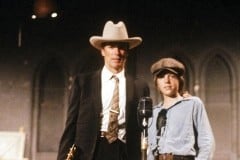
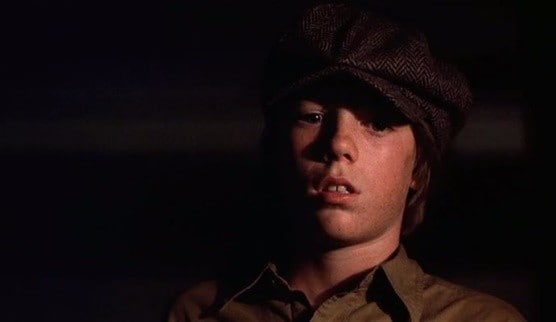
The action in Honkytonk Man is set in the years of the Great Depression in the American Southwest. Fourteen-year-old Whit (Kyle Eastwood) is helping his parents prepare for an upcoming storm at their family-owned farm. Suddenly, in the midst of the storm, a wildly maneuvering car appears and crashes into a wooden windmill. The driver is soon revealed to be Whit’s uncle, “Red” Stovall (Clint Eastwood), famed songwriter and country singer – who is on his way to an audition at Nashville’s Grand Ole Opry. He is dead drunk, and it soon becomes clear he’s also suffering from tuberculosis. The young Whit bonds with his free-spirited uncle who treats him as a friend instead of as the little kid he is – an approach that wins the boy’s heart. And then there’s his uncle’s guitar in which Whit shows great interest.
The boy expresses his wish to accompany his uncle to Nashville – something he sees as an adventure and a way of replacing the daily farm routine with the chance to “…be somebody”. Naturally, Whit’s parents aren’t thrilled with the idea – but they let him go because they are afraid that his uncle’s condition may become worse. The rest of the story follows their exploits on the road, where they experience thrilling adventures and meet some interesting characters. Among the latter are singers (Blues and Country stars), scammers (they get shot at), policemen, and ladies of questionable repute (which leads to Whit’s first sexual encounter). These experiences are new and exciting to the young boy – and offer him an opportunity to peek into the world of adulthood– a world to which he will soon be entering. His uncle is both a mentor and a friend to the kid, showing him the manly things to do (most of which happen to be things that his parents wouldn’t approve).
I really like the filmand there is more than one reason for that.While the story is not complex or suspenseful, it does feature plenty of funny and heartwarming scenes. As I said in my recent review of The Cowboys — about not being that familiar with the American Western star John Wayne prior to seeing that movie — I also haven’t seen many movies with Clint Eastwood – so I had the opportunity to form an unbiased opinion of his acting. Not only was I impressed by it – his singing skills are on par with his acting.
Clint Eastwood
Intriguingly, the film does not feature any non-diegetic music (none that came from an external source of the story itself) as all the songs were either performed by Clint Eastwood’s character or played on a radio the characters were listening to. This enhanced the film’s mood – and especially its ending — which is by far one of the most creative and memorable endings of a film you will ever see.
But if Clint Eastwood was good, the performance of his son, Kyle Eastwood as Whit, impressed me even more. While this could also be attributed to skilful editing, every time he appeared on camera, he had some facial expression emitting shyness, curiosity or just plain confusion — in a truly natural way. As the story developed so did his expressions, which clearly illustrated the Rite-of-Passage he was going through. His good looks and adorable appearance are another extra.
Kyle Eastwood as Whit in Clint Eastwood’s 1982 Honkytonk Man
Unlike most films I have seen, the actors portraying the characters that the protagonists encounter on their journey are equally memorable. From the Black Blues singer to the policemen, to the mechanic who gets hired to fix Red Stovall’s car – while I can’t recall the name of the actors, their characters are alive in my mind while writing this review.
When it comes to the film’s visual aspects – medium close-ups and close-ups of the characters are sparingly used, which increases the emotional value of the film by making the already touching story even more poignant. A lot of attention has been paid to the film’s lighting, with shadow lighting techniques being used to significant effect.
For a film length that exceeds two hours, I was never once bored and kept rooting for a successful outcome of the journey of Red Stovall and his nephew. Honkytonk Man turned out to be one of the best Coming-of-Age films I have seen. I did not even mind the fact that the narrative was not told in the first person – as it was genuinely engaging.
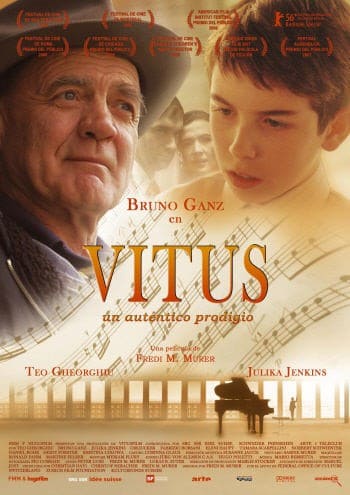
Vitus is the story of an amazing child prodigy with an IQ that is off the charts at 180. Before Vitus is old enough to go to school, he is already accomplishing things that astound every adult who comes in contact with him. At the age of six, he enjoys his reading directly from encyclopedias and discovers the meaning of words like “paradoxical” directly from the dictionary — completely on his own.
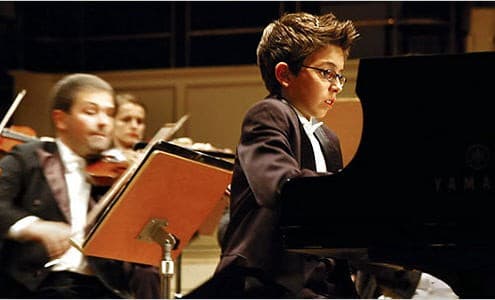
Due to his overwhelming interest and passion for the piano, he excels beyond his teacher’s ability to instruct him, and of course finds it increasingly difficult to be challenged academically with children his own age. After being booted out of one school due to outshining a teacher, he is continually advanced to higher grade levels with students with whom he has nothing in common due to the drastic difference in age.
While you may think it would be wonderful to be so advanced intellectually, Vitus finds his genius to be a curse at times and only seeks to be normal. His parents love him dearly but his mother is consumed by her own ambitions for Vitus to become a concert pianist, and his father is continually absorbed in business affairs. This leaves Vitus feeling conflicted and hopelessly lost. Because his friends and relationships are limited, he finds his greatest ally and friendship in his grandfather who seems to be the only one who really understands him.
Fabrizio Borsani as Vitus
Vitus only wants to escape from the trap in which he has found himself. When asked one day; “What do you want do for a career by his granddad, Vitus replies, “I just want to be someone else!” “Who then?” his grandfather asks. “Anyone”, Vitus replies, “I just want to be normal!”. “Then be normal”, his grandfather suggests. “But how?”, Vitus asks. To that his grandfather tosses his hat in the air and says: “If you can’t decide then you’ll have to part with things you like…”
To reveal any more of the story would make this review a spoiler. Let’s just say that Vitus finds a very unusual way to escape the trap that he finds himself in, and still manages to utilize his genius to not only improve his life but his entire family’s as well.
The acting in this movie is superb and I especially found myself captivated with both boys who played the lead role of Vitus: Fabrizio Borsani (age 6) and Teo Gheorghiu (age 12). Both boys are natural in their portrayals of a youngster advanced in communication and intellectual reasoning.
Teo Gheorghiu as Vitus
Director Fredi M. Murer has done a great job using camera close-ups to draw the viewer into the movie, and in other ways encapsulating the film’s audience into the story rather than leaving the viewer only as an observer. The writers have created amazing dialog and a thorough characterization of Vitus, producing a character who is both witty and intelligent, but also passionate and loving.
The film is produced in the German language but subtitles are available in several languages.
I highly recommend this film if you have not seen it. It’s an uplifting story that makes you laugh at times, and it will find a place in your heart long after you have watched it! It is rated PG and is suitable for the entire family!
Rivenmaster’s Place has become the global home to young signed and unsigned vocalists, aspiring young actors and talented youth. You will enjoy outstanding articles that are derived from speaking directly to the parent of the child and also personal interviews with the young celebrity. Many young people have been given even greater opportunity to expand their careers due to the dedication and effort of this site! For more information visit:Rivenmaster’s Place. Or write to: writemeone@hotmail.com
“Reading books can be a lot of fun when they are not the same ones they make you read over and over and over till you want to shoot yourself.”
Quoting the protagonist of Frank Portman’s novel King Dork is just about the best way I can think of to open its review — for I chose the book on my own, expecting it to be entertaining, and it did not disappoint me. Frankly one can apply this quote to almost anything in life (including writing book and movie reviews) and it still holds true. Basically King Dork has a Coming-of-Age theme, but
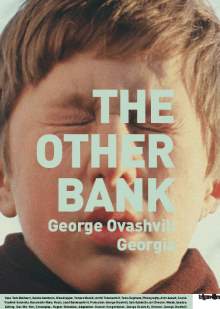
Once again I see a film after being enticed by its trailer; that and my curiosity to watch a Coming-of-Age story that is both set and produced in Georgia and Abkhazia. The protagonist of the 2009 Georgian film The Other Bank is the 12-year-old Tedo (Tedo Bekhauri), a war refugee struggling to make a living on his own.
Music to make music to learn those places to press down strings to place fingers perfectly on keyboard while the other one strums tempo to add voices treble-pitched to place capo matching key to those black and white sounds echoed with bar chords to perform live and make mistakes two young brothers from Austin Texas from the ‘lil Vietnam coffee shop from the Triumph Cafe where they first performed from the hands of a teacher who guided the fingers into the frets where they now find their way routinely but it took Kyle a while to learn them from Paul and the boy on keyboard is brother Ben who learned from Layla it is music to learn to cast spells over people grouped ready to listen to be enchanted it is The Good Life by One Republic practicing those tunes for hours it is Ambition‘s bubbling young fountain supported by Beth Sand‘s local guitar shop and it is a whole school of American music it embarks on harmonies from decades of spellbinders it’s ready to Fix You in just two years it has sprouted-out forty five live shows in California where we know dream factories thrive they are Sharp to make music these brothers Ben and Kyle if only they could get to The Hoot if only they could be liked liked liked enough then off to The Spectrum to Seaport Village McKim for the masses or maybe Daylight by Maroon 5 as long as it’s music memorize harmonize finish nice and take a bow and somehow somewhere later on that magic musical moment will suddenly arrive and a crowd will be suspended on a wave of enchantment as their diligent craftsmanship finally arrives like a wave washing over Laguna Beach over people-pebbles with salt in their eyes who turn to each other and ask surprised who are these boys? and where did they learn to make music music
for benjamin+kyle sharp
Quote from a YouTube reply: “We have played 45 live shows this past year–we do not pre-record–we play live music — one chance to get it right!” — SharpTurnAhead (age 13)
The gap between generations is the main theme of the 2010 Bulgarian film Podslon (Shelter). Unless you have attended a festival where the film has been shown, it’s highly unlikely that you have heard of the movie, which is a shame as it is one of the few Bulgarian films with a Coming-of-Age narrative released after 2000.
There’s so much I can tell you about Broadway. Many shows have come and gone over the history of the city of New York, and a good many streets make up what “Broadway” really is. Of course it hasn’t just been about Broadway the road for a very long time now. But until recently, I never knew there was a street that directly connected Broadway with the state of Iowa. Who knew? It’s a very happy street with colorful signs and trees, even a few rest stops along the way and—is that a tutu? And though the street belongs to Alex Ko
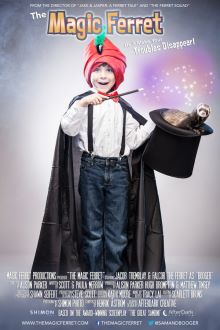
In 2011, a review of Alison Parker’s short film Jake & Jasper: A Ferret Talewas published on this site. Recently I became aware that Director Parker has launched a fundraising campaign with the goal of financing yet another short film starring the enthusiastic and sympathetic young actor Jacob Tremblay (The Smurfs 2) and …..you guessed it: a ferret.
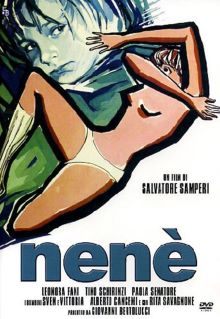
Very few movies feature narratives which focus on youth sexuality without being exploitive, manipulative or filled with fictitious happenings. Savatore Samperi’s film Nenè is one that avoids those pitfalls. While its plot doesn’t feature suspenseful scenes or surprising story twists, it genuinely portrays the voyage of a seven-year-old boy and his 14-year-old cousin, from childhood to adulthood.
One doesn’t always stumble upon excellent movies, but in almost every film one can find something of value. In Gravel Road, a short film film by Keith Fleetwood, the value lies in its soundtrack and in the final message. Starring J.D. and Sam Hunt, the film tells the story of two brothers subjected to physical and psychological abuse from their father, who had become an alcoholic when his wife died. When a teacher notices the bruises on the kids, a report is filed with the Social Services.
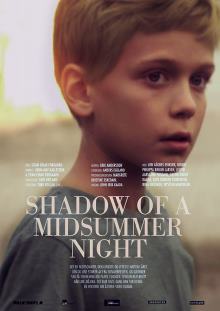 Shadow Of A Midsummer Night ( Midsommernattens Skygge) is a short Coming-of-Age film from Norway about a nine-year-old boy who loses his friend in an accident.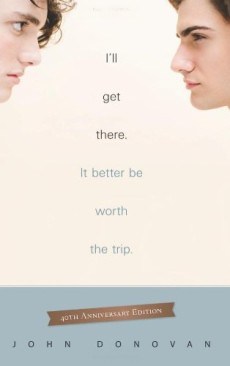

 At the new private school in Manhattan to which Davy is sent (despite the fact there is an abundance of public schools near the snotty apartment he shares with his mother), Davy meets Altschuler- a boy who despises Davy at first (because the new kid has taken the place of his best friend who is sick with leukemia and has had to stop attending school). Altschuler is a popular kid at the school and doesn’t lack confidence, which Davy (while mature beyond his years) is still to attain. So the boys’ relationship is off to a rocky start, but it soon develops in an unexpected direction…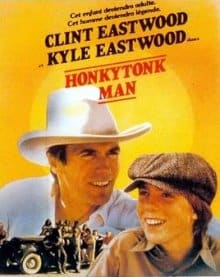
 The boy expresses his wish to accompany his uncle to Nashville – something he sees as an adventure and a way of replacing the daily farm routine with the chance to “…be somebody”. Naturally, Whit’s parents aren’t thrilled with the idea – but they let him go because they are afraid that his uncle’s condition may become worse. The rest of the story follows their exploits on the road, where they experience thrilling adventures and meet some interesting characters. Among the latter are singers (Blues and Country stars), scammers (they get shot at), policemen, and ladies of questionable repute (which leads to Whit’s first sexual encounter). These experiences are new and exciting to the young boy – and offer him an opportunity to peek into the world of adulthood– a world to which he will soon be entering. His uncle is both a mentor and a friend to the kid, showing him the manly things to do (most of which happen to be things that his parents wouldn’t approve).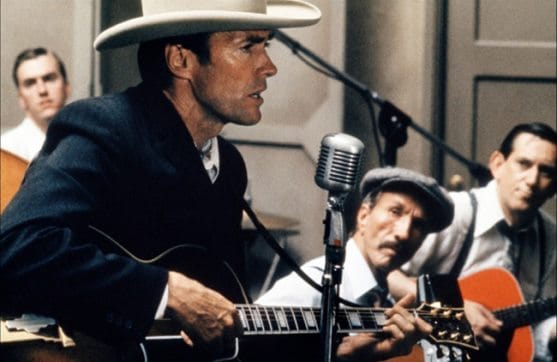


 Music
Music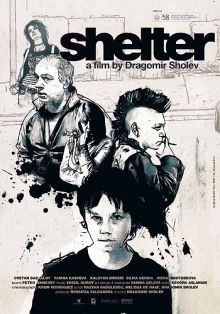

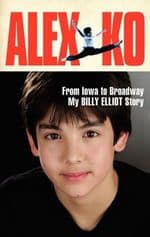 There’s so much I can tell you about Broadway. Many shows have come and gone over the history of the city of New York, and a good many streets make up what “Broadway” really is. Of course it hasn’t just been about Broadway the road for a very long time now. But until recently, I never knew there was a street that directly connected Broadway with the state of Iowa. Who knew? It’s a very happy street with colorful signs and trees, even a few rest stops along the way and—is that a tutu? And though the street belongs to Alex Ko